LAST UPDATED: 08-09-26
How we're doing
against previous target
Social
Customer contacts about water qualityInterruptions
Developer Measure of Experience (D-MeX)
Leakage
Compliance Risk Index (CRI)
Customer Measure of Experience (C-Mex)
Business Retailer Measure of Experience (BR-MeX)
Create more partnership community projects on water use and vulnerability
Mains repairs
Unplanned outage
We supply first-class drinking water to 2.3 million customers through 9,000 miles (more than 14,000 kilometres) of pipes.
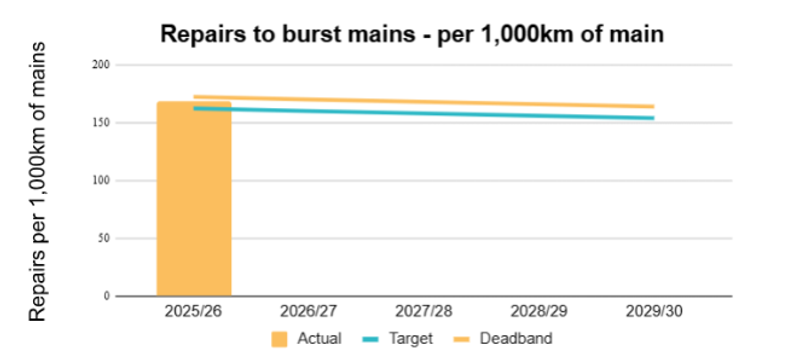
This performance commitment measures the number of repairs we carry out to burst mains for each 1,000 kilometres of pipeline in our network.
Our target for 2025/26 is 162.2 repairs per 1,000 km. A deadband, (which is a specified range of performance levels where the ODI underperformance or outperformance payment is zero) has now been included in this measure, which is the equivalent of 10 repairs per 1,000km of main. This means that for 2025/26 the deadband level is 172.2, if performance is higher than this we’ll receive a financial penalty.
How have we performed?
Performance for the year was 168.6 and therefore higher than our 162.2 target, however remained within the deadband and therefore does not incur a penalty payment.
Throughout the year, we have remained dedicated to reducing leakage, resulting in a notable increase in proactive water mains repairs.
Historically, customer-reported issues accounted for approximately 70 per cent of all repairs; however, this figure has since decreased to roughly 60 per cent.
We have expanded our leak detection and repair teams, which has naturally led to a higher volume of maintenance activities. We anticipate this trend will persist over the coming years as we further intensify our efforts to reduce leakage and alleviate network demands.
Significant peaks in repair activity were seen during the summer months of July and August, as well as in January. These periods coincide with elevated network demand and adverse weather-related ground movement, such as freeze-thaw cycles and extended dry spells.
These periods also saw the highest number of proactively identified repairs, underscoring our ongoing commitment to reduce leakage.