LAST UPDATED: 07-09-26
How we're doing
against previous performance
against previous target
Social
Customer contacts about water qualityInterruptions
Developer Measure of Experience (D-MeX)
Leakage
Compliance Risk Index (CRI)
Customer Measure of Experience (C-Mex)
Business Retailer Measure of Experience (BR-MeX)
Create more partnership community projects on water use and vulnerability
Mains repairs
Unplanned outage
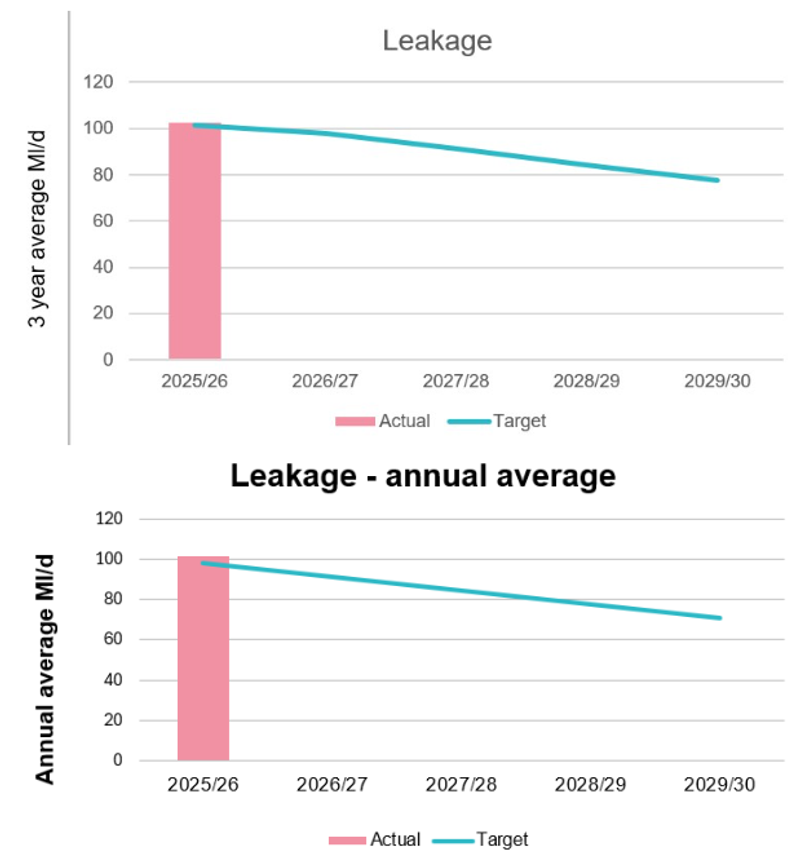
The amount of water leaking from our network is a top priority for us and we know it’s important to you too.
We aim to cut the amount of water leaking from our network or from the pipes in your homes by 28 per cent between 2025 and 2030 (based on our annual performance). This keeps us on track to cut leaks by 50 per cent by 2050.
We measure leakage in megalitres or millions of litres, per day (Ml/d). Our target is to cut leaks down to 70.5 Ml/d by 2030. If we do better than our target, we could receive an outperformance payment. If we miss our target, Ofwat will penalise us.
During 2025/26 our targets were to reduce leakage:
- To 97.9 Ml/d (annual average) during 2025/26
- To 101.4 Ml/d (against our three year average)
- By 6.6 per cent against our 2019/20 three-year average baseline
How have we performed?
During 2025/26 we :
- Reduced our annual average to 101.1 Ml/d. A reduction of 3.7ml/d from last year.
- Reduced our three year average leakage to 102.4 Ml/d.
- We remain higher than our 2019/20 three-year average baseline of, 7.6 per cent. However this has reduced from 8 per cent last year.
This performance has resulted in a penalty of £0.66m being incurred.
We share our customers' frustrations at seeing drinking water lost to leaks, but please be assured that we are working as hard as we possibly can to reduce leakage across our network.
We are prioritising fixing these leaks as quickly as possible and have brought in additional repair teams to assist. Once our technician has reviewed a reported leak and confirmed a repair is needed, the typical duration for completing a repair has been halved compared to the same period last year.
A range of factors come into planning a repair which can impact how long a leak takes to be fixed after it’s been reported. These include the location of the leak, the traffic management required, environmental considerations, permit requirements, other nearby utilities and the risk of customers going without water supply.
Clearly if there is an emergency leak or burst affecting drinking water supplies, these are always prioritised.
We spend around £63 million a year on finding and fixing leaks across the network and are committed to investing further to reduce the amount of water lost to leaks by half by 2050.
In the last year, we have found and fixed over 21,000 leaks on our network, and a further 6,000 customer-side leaks. This is around a 10 per cent increase on the previous year. We have more staff than ever finding and fixing leaks. In total, we have 400 people working on repairing leaks when they are reported, with a further 101 technicians searching for and finding leaks proactively.
We’d like to thank everyone who takes the time to report leaks to us - it really does help us to find and fix problems in our network.
If anyone spots a leak, it can be reported to us through our online AquAlerter platform(opens in a new tab).