LAST UPDATED: 08-09-26
How we're doing
against previous target
We use a lot of energy extracting, cleaning and pumping water to our customers’ taps.
Moving to low-carbon operations will help us make our business more sustainable and also help us tackle the causes of climate change.
We’re doing everything we can to support our industry’s goal to be net zero carbon for operational emissions by 2030 and net zero by 2050. This includes being more energy-efficient, using renewable sources, avoiding direct emissions, working with customers, and investing in nature-based solutions.
How have we performed?
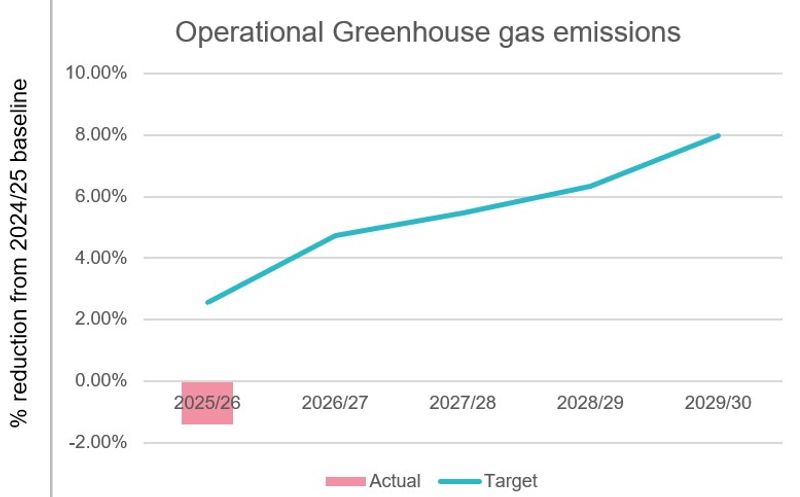
We are fully committed to accelerating our operational carbon reductions by 2030, serving as a critical milestone towards achieving net-zero emissions by 2050. Specifically, from our 2024-25 performance of 51,678.17 tCO2e, we aim to reduce our operational greenhouse gas emissions for water services by 7.97 per cent by 2030. We have unfortunately seen a small increase in our operational greenhouse gas emissions in 2025-26 of 1.14% up to 52404.85 tCO2e. We have therefore earned a small penalty of £0.383million.
Extracting, treating, and pumping water to our customers' taps is an energy-intensive process. Transitioning to low-carbon operations is vital, not only to future-proof our business but to actively combat the root causes of climate change. To achieve these targets, we are focusing on key operational efficiencies and clean energy transitions:
- Energy and infrastructure efficiency: We optimise energy efficiency across our assets and have active projects underway to introduce onsite renewable energy generation. We are also evaluating a shift from traditional diesel backup generators to clean, onsite battery storage systems.
- Electric vehicles: We continue to transition our commercial vehicle fleet to electric vehicles (EVs). To foster a culture of sustainability, we also support our employees with EV salary sacrifice schemes and the expansion of workplace charging infrastructure.
- Network and demand management: Helping our customers use less water and reducing leaks on our network directly lowers our pumping and treatment requirements, shrinking our carbon footprint.
We have secured a new green Power Purchase Agreement (PPA) to source renewable wind energy via the grid. This wind farm is scheduled to go live in October 2027 and will supply approximately 35 per cent of our annual energy requirements. While grid-sourced renewable energy does not impact our regulatory targets, this PPA will deliver a substantial, meaningful reduction to our actual carbon footprint. Alongside this, we continue to progress our onsite solar projects and explore further market opportunities for renewable power.